
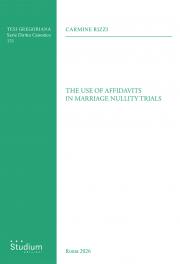
The use of affidavits in marriage nullity trials
The dissertation is divided into three chapters. The first chapter traces the history of written documents as a type of evidence in courts, beginning with Roman Law, through Medieval canon law, into the early modern period, and finally to contemporary American civil law. The course of a civil trial, and the different types of evidence that can be presented, is then considered. Finally, the requirements to produce affidavits, and the ways that they can be used are considered.
The second chapter is divided into four parts. The first part examines the canons on proof in the 1983 Code of Canon Law. The second part examines the canons on the judicial examination. The third part considers the historical context that gave rise to the canonical trial, and the marks of the canonical trial. The last part looks at principium V, that is, the fifth of the ten guiding principles of the Code revision, which established uniformity in procedural law.
The third and final chapter looks at the use of affidavits in American ecclesiastical tribunals. The term «affidavit» does not appear in the 1983 Code of Canon Law, nor in legislation outside of the Code; it does, however, appear in the sentences and decrees of the Tribunal of the Roman Rota, when referring to the «American way» of collecting proofs. The chapter ends with an analysis of affidavits from the perspective of procedural law, and the proper use of an affidavit while evaluating proofs, in light of the standard of moral certitude.
Recensioni
Carmine Rizzi
> torna suborn in 1987, is a priest of the Archdiocese of Newark, New Jersey since 2013. He obtained the License in Canon Law from The Catholic University of America in Washington, D.C. in 2018, and the Doctorate in Canon Law from the Pontifical Gregorian University in 2025. He is currently serving his archdiocese as the Judicial Vicar.
Caratteristiche
Anno: 2026Numero pagine: 264
ISBN: 978-88-382-5690-5


Commenti
> torna su